
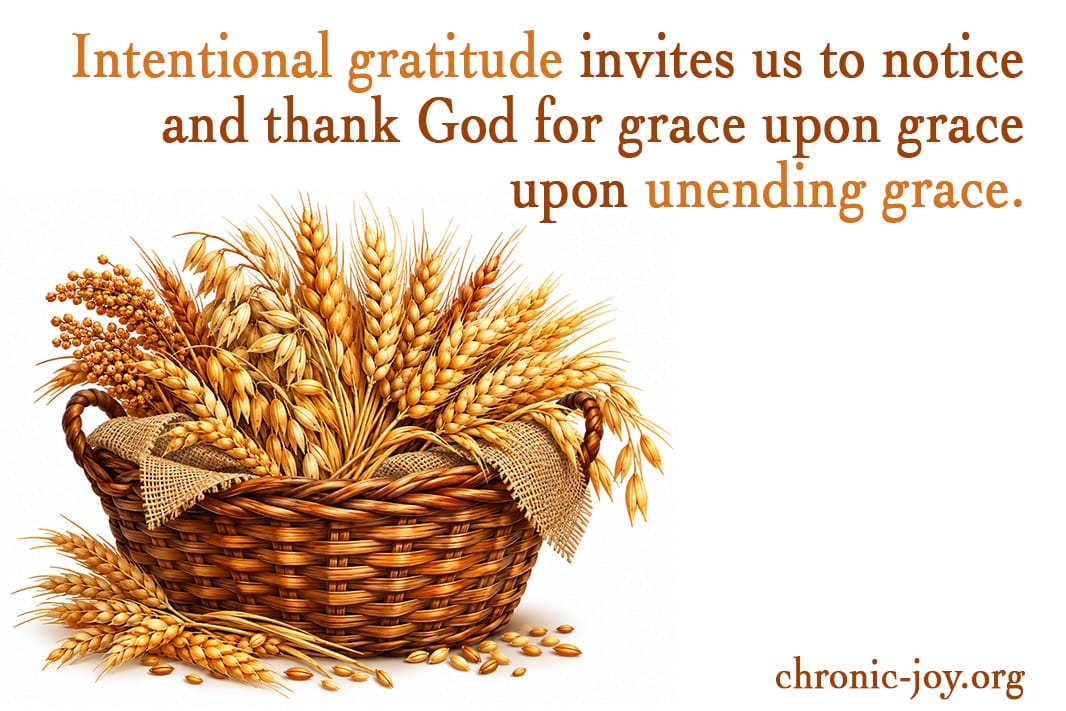
Intentional gratitude invites us to notice and thank God for grace upon grace upon unending grace.
GRATITUDE AND HARVEST
Gratitude can feel elusive in the midst of chronic pain and illness. Yet whether shrouded in fog, buried beneath loss, forgotten in a dusty corner, or barely perceptible through tears, hidden seeds of gratitude lie quietly within our souls. When tended, they take root and, in God’s perfect timing, ripen into a harvest of maturity ...
… even when we are overwhelmed.
… even when we cannot speak.
… even when our circumstances feel impossible.
… even in the midst of chaos.
… even when we squint against a colorless sky.
Gratitude plants the seeds that, in God's perfect timing, will emerge from our long winter seasons into spring's lengthening light, flourish in summer's heat, and ripen into an abundant harvest of fruit: love, joy, peace, patience, kindness, goodness, faithfulness, gentleness, and self-control.
FROM GRATITUDE TO HARVEST
Intentional gratitude begins when we notice individual grains of grace, then lift our thanks for:
- a shaft of sunlight dancing among the leaves
- a fresh cup of tea
- the smell of clean laundry
- an unexpected sweet memory
NOTICING DETAILS
Edward King (1829-1910), Bishop of Lincoln, wrote this about gratitude:
I will thank God for the pleasures given me through my senses, for the glory of the thunder, for the mystery of music, the singing of birds and the laughter of children. I will thank God for the pleasures of seeing, for the delights through colour, for the awe of the sunset, the beauty of flowers, the smile of friendship, and the look of love; for the changing beauty of the clouds, for the wild roses in the hedges, for the form and beauty of birds, for the leaves on the trees in spring and autumn, for the witness of the leafless trees through the winter, teaching us that death is sleep and not destruction, for the sweetness of flowers and the scent of hay. Truly, oh Lord, the earth is full of Thy riches!
In The Sound of Music, Julie Andrews sings about a few of her favorite ordinary things:
- raindrops on roses
- whiskers on kittens
- bright copper kettles
- warm woolen mittens
- cream-colored ponies
- crisp apple strudels
- schnitzel with noodles
Both the quote and the lyrics invite us to notice the details of daily life and to pay attention to the lucid grains of grace tucked into our ordinary, everyday moments.
NOTICING GIVES GRATITUDE ROOTS FOR DARK DAYS
In the book Acceptable Words: Prayers for the Writer, Gary D. Schmidt and Elizabeth Stickney write:
The writer is aware of the miracle of a maple tree bark, even though she may be in a forest of maple trees ... the cracks in this one sidewalk he walks on, even though he is walking in a city of sidewalks ... the smell of salty pretzels, the beat of the sun at the high altitudes, the lonely cry of a train whistle across cornfields …
Noticing gives gratitude roots for the dark days and snowy seasons, quietly cultivating a bountiful harvest within our souls.
Robert Louis Stevenson wrote this about the harvest of noticing: And now, when the clouds gather and the rain impends over the forest and our house, permit us not to be cast down; let us not lose the savour of past mercies and past pleasures; but, like the voice of a bird singing in the rain, let grateful memory survive in the hour of darkness.
A HARVEST OF GRAINS
From a distance, a field of grain moves as one undulating wave beneath the autumn sun. There is beauty in that golden sea. A field reminds us to lift our eyes toward the horizon—to watch the ocean stretch blue as far as we can see, or to tip our heads back in wonder beneath the vast, endless sky. Yet it is a single grain that begins to nourish and sustain. A single grain reminds us to pause and pay attention—to notice a sip, a bite, a touch, a breath, a seed, a creak, or a snap. Both give form and rhythm to our days. Both invite us to behold. Both draw us deeper into Jesus. Both nourish and sustain.
Intentional gratitude teaches us to notice and thank God for grace upon grace upon amazing grace. One grain at a time, thanksgiving gathers—and in God’s hands, those tiny grains can become a bountiful harvest.
NOW IT'S YOUR TURN TO NOTICE THE DETAILS
Set aside a few minutes today to simply notice what is around you:
- sunlight through a window
- the smell of rain-washed earth
- the nuzzle of a puppy
- an interesting shadow
- the laughter of a child
- the scent of an orange as it's peeled
- cool water flowing from the tap
- the familiar creak of a floorboard
- the sigh of the wind in the pines
Collect the moments. String them together. Play with line breaks and the rhythm of words. Let them dance, sing, move, and breathe. When you're ready, write them down. You might discover that what seemed scattered and unconnected is something more, something deeper: grains of grace, rooted, growing, and ready to be gathered into a harvest of gratitude.
For many years, I noticed and watched sandhill cranes, then collected phrases about them in a small notebook: a crimson cap, a clattering call, wings stretched wide, the gathering sedge, leaping and tossing sticks in the early spring sun. As I paged through those fragments, a poem began to emerge. I gathered the details onto a single sheet of paper and played with them—changing word order, listening for rhythm and flow, allowing lines and stanzas to form and reform. The details began to take shape, each small observation finding its place until, little by little, they grew into the poem below.
CANTICLE OF THE CRANES
They arrive with the first breath of spring trailing
behind them, still many weeks off. Do they
sense it on the horizon? Do they taste it in the tender
tuber shoots? Or is this annual convergence of
half a million cranes, a date imprinted on their DNA,
a primal tug to pull up stakes and fly almost 500
miles a day to their nesting grounds? They must
be exhausted, this migrating pair, awash in
the afternoon sun. But the sedge has gathered.
It’s nearly time to prepare last year’s mounds
for this year’s eggs. But first … They dance!
Pumping crimson caps, leaping, wildly stretching
their wings, and flinging sticks to the wind,
courting their life-long mates. I wonder if they ever
miss their days with the bachelor flock, or if
they are settled now, raising their annual doublet
of colts, who strike out of the nest in less than a day,
easy prey for a sharp-eyed owl, a quick-winged hawk,
or a scavenging coon. How soon are they taught
to beware of their predators? Am I a hunter, too,
lying in wait—not to band or clip or eat, but to
capture in image, these birds who stir my soul
with their ancient clattering call? How many springs
will these cranes return? Will their duet outlast my own?
GATHER YOUR GRAINS OF GRACE
Perhaps gratitude does not always begin with abundance. Perhaps it begins with one small thing noticed and named: one slant of sunlight, one familiar voice, one breath drawn deeply, one memory that still warms us, one mercy carried forward. Difficult days may not be good, but even then, holy grains of grace—like manna—are sown into each day. We do not have to gather enough for tomorrow; only what God provides for today: one grace, one mercy, one small sustaining gift at a time—for even the smallest grains of grace can nourish us.
Over time, the grains gather. Gratitude takes root—and what once seemed almost imperceptible may, by God’s grace and in His perfect timing, become a harvest.
QUESTIONS FOR REFLECTION
- What small detail caught your attention today—a sound, scent, color, texture, movement, taste, or touch?
- Look closely at something familiar. What do you notice now that you had never noticed before?
- What have you noticed repeatedly lately? Could God be inviting you to pay closer attention?
- What have you been collecting without realizing it—phrases, images, sounds, memories, or questions?
PRAYER
Lord, open my eyes to the grains of Your grace in this day. When pain, loss, or weariness cloud my vision, help me notice Your present gifts and remember past mercies. Gather my small thanksgivings and plant them in my soul. Through every season—winter, spring, summer, and harvest—grow in me the fruit of Your Spirit and a heart that recognizes Your goodness in all things. In Jesus’ holy name, amen.


Cindee Snider Re
Author, Designer, and Co-Founder of Chronic Joy®
Cindee is married to the man she loves most in this world, mama to five adult kids, four of whom are married, and Lolli to three adorable grandchildren. Cindee and her five kids have Ehlers-Danlos, intractable migraines, and myriad co-existing conditions. While a life steeped in illness is not what she would have chosen, through it, she’s learning that the deeper the valley, the greater her capacity for joy.
Cindee is the author of Discovering Hope, Finding Purpose, Embracing Worth, and I Take You in Sickness and in Health.
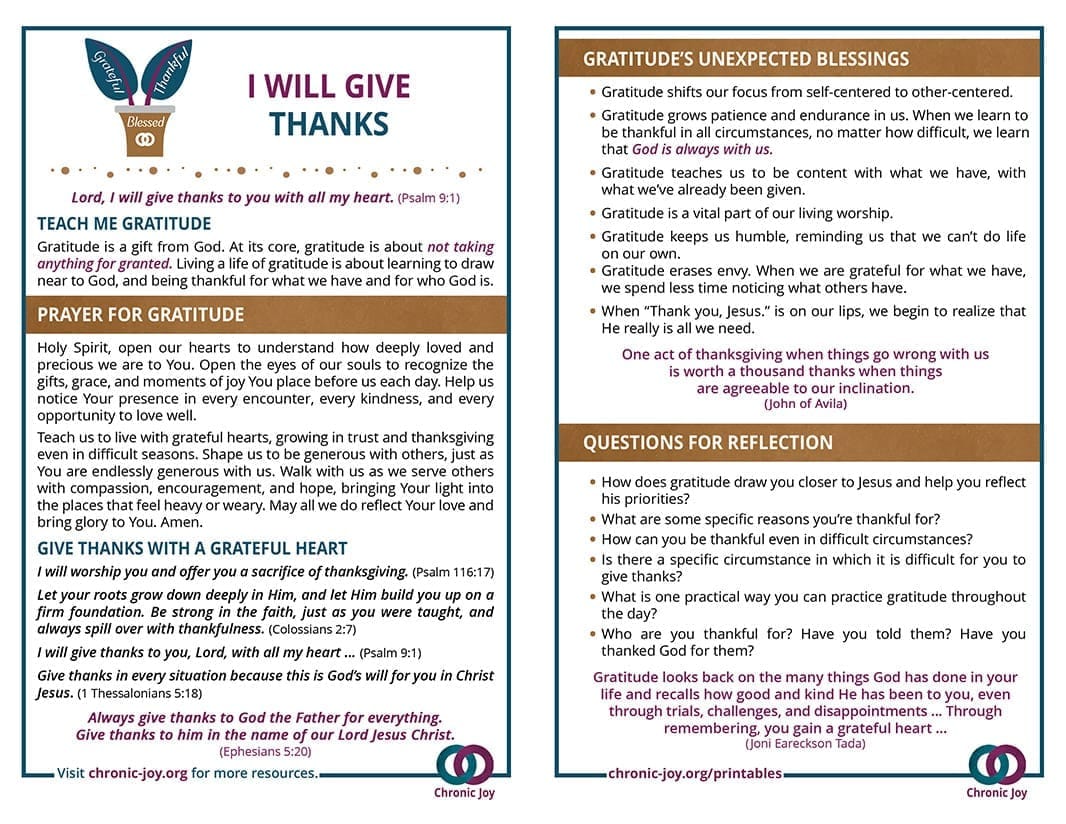
I Will Give Thanks
Gratitude is a gift given to us by God. At its core, gratitude is about not taking anything for granted. Living a life of gratitude is about learning to draw near to God, being thankful for what we have, for who God is, and for who He created us to be.
Recent Comments